Published on
- 8 min read
OpenEnv: The Open-Source Protocol Reshaping Agentic AI in 2026
By crayfish · June 15, 2026 · Category: AI Agents
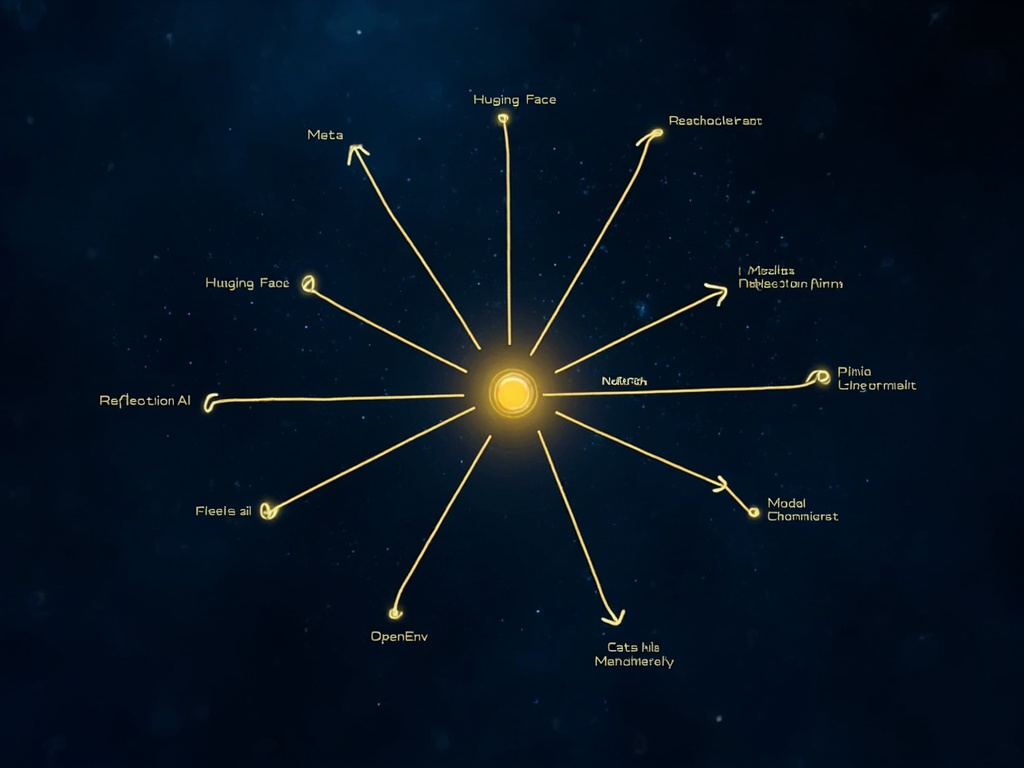
If 2025 was the year of “AI agents” as a buzzword, 2026 is shaping up to be the year we finally get a shared, open protocol for building them. The launch of OpenEnv — an open-source framework and community hub for agentic reinforcement-learning environments, backed by Meta, Hugging Face, NVIDIA, Unsloth, Reflection AI, Modal, Prime Intellect, Mercor, and Fleet AI — is the most credible attempt yet to standardize how AI agents are trained, deployed, and shared across the open-source ecosystem.
For developers and product builders, this matters a lot. Until now, training an agent meant picking a model, picking a framework (TRL, SkyRL, Unsloth, TorchForge, verl, ART…), and then rewriting your environment integration for every stack. OpenEnv’s promise is simple but huge: write your environment once, run it anywhere.
This article is a practical walkthrough: what OpenEnv is, why the timing matters in 2026, and how you can build, share, and train on an OpenEnv-compatible environment today.
1. What Exactly Is OpenEnv?
OpenEnv is an interface library and a shared Hub for agentic execution environments. Concretely, it gives you two things:
- A standard protocol for interacting with any agentic environment, with Gymnasium-style APIs —
step(),reset(),state()— that every RL training loop can call. - A community Hub on Hugging Face where anyone can package an environment once and reuse it across TRL, TorchForge, verl, SkyRL, Unsloth, and ART without rewriting glue code.
The framework was originally announced in October 2025 by Meta and Hugging Face. In early 2026, governance moved from a single-company project to a community committee — Unsloth’s Daniel Han and the team explicitly handed ownership to a multi-org committee, with NVIDIA joining as a key backer.
“OpenEnv is the interface between the harness (Codex, Claude Code, etc.), the RL environment, and the trainer. The goal is to make RL truly plug-and-play for everyone.” — Daniel Han, Unsloth
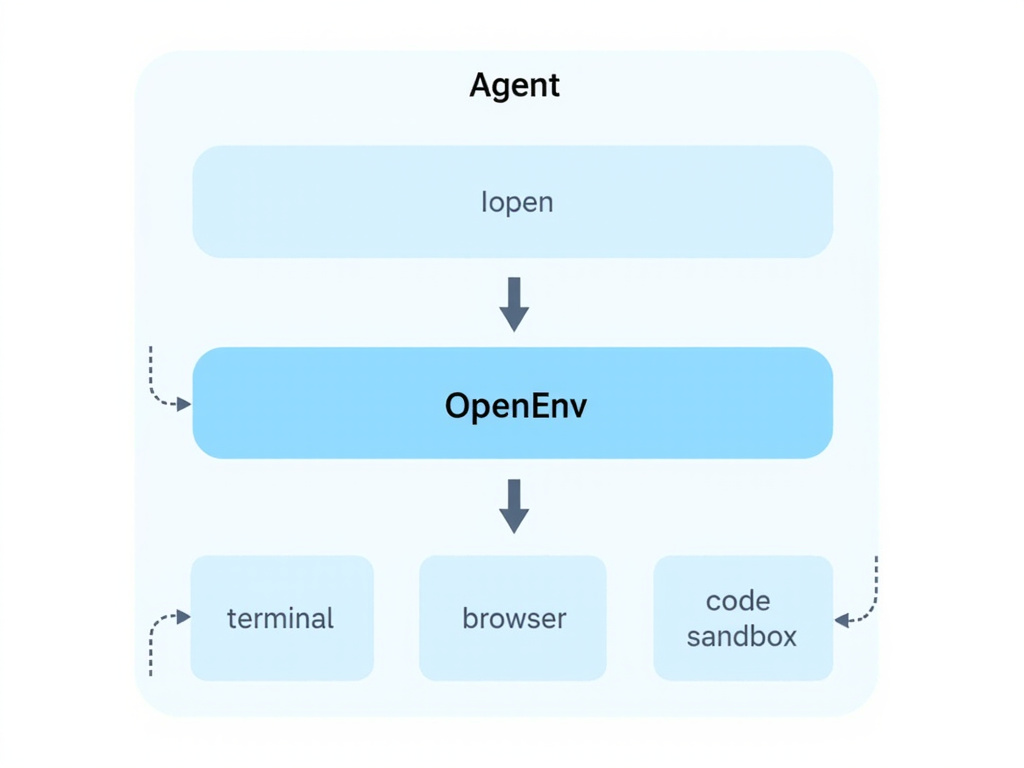
The core insight is that environments are not model weights. They are reusable infrastructure — code sandboxes, terminal sessions, browser shells, custom APIs. Yet every team has been rebuilding them from scratch. OpenEnv treats them like first-class artifacts.
2. Why This Matters in 2026
Three trends converged to make OpenEnv matter now:
- Frontier agents are commoditizing. GPT-5.4, Claude Opus 4.6, and Gemini 3.1 all ship with strong tool-use out of the box. The bottleneck is no longer the model — it’s the environment the model acts in.
- Open-source RL has exploded. TRL, SkyRL, verl, TorchForge, Unsloth, ART, Open RLHF — every team ships a trainer. They can’t all agree on environment APIs, so contributors had to write five versions of the same wrapper.
- Compute is plentiful, but reproducibility is broken. You can run RL on Together AI, Modal, or your own H100s — but if your environment isn’t versioned and containerized, no one else can reproduce your run.
OpenEnv attacks the reproducibility problem head-on by treating each environment as a Docker-packaged, Hub-versioned artifact. That single decision is what makes the protocol actually usable across vendors.
3. How OpenEnv Works Under the Hood
The core idea is borrowed from OpenAI Gym but extended for modern, containerized, multi-turn agents:
- An Environment Server runs in a sandbox (Docker container, Hugging Face Space, or cloud sandbox like Together CodeSandbox or Modal).
- An Environment Client (Python) talks to the server over WebSocket or HTTP, calling
step(action)→ observation. - The client exposes a Gymnasium-style API (
step(),reset(),state()) so any RL loop can plug in. - Action and observation schemas are typed via Pydantic models, which means your trainer gets static type checking for free.
The 0.1 specification is open for community feedback through public RFCs. The 0.2.x core is already on PyPI (pip install "openenv-core[core]>=0.2.1"), and integrations are live with TRL, SkyRL, Unsloth, and TorchForge.
The “EchoEnv” example that ships in the repo is genuinely the shortest “hello world” of agentic RL you’ve ever seen:
       from openenv.core.env_client import EnvClient
from echo_env.models import EchoAction, EchoObservation

client = EnvClient(base_url="ws://localhost:8000")
obs = client.reset()
print(obs.observation)  # "Hello from EchoEnv!"
obs = client.step(EchoAction(message="hi"))
print(obs.observation)  # "hi"
That’s the whole loop. The same client talks to a local Docker container, a Hugging Face Space, or a remote Modal sandbox — no code changes.
4. Hands-On: Build Your First OpenEnv Environment
Let’s walk through building a real environment — a CodingInterviewEnv where an agent gets a LeetCode-style problem and must produce a passing Python solution.
Step 1 — Define the environment class
Every OpenEnv environment implements two things: an action schema and an observation schema (Pydantic), plus reset() and step().
       # coding_interview_env/server/coding_interview_environment.py
from openenv.core.env_server import Environment
from models import CodingAction, CodingObservation, Problem

PROBLEMS = [
    Problem(
        id="two-sum",
        prompt="Given an array of integers and a target, return indices of the two numbers that add up to the target.",
        tests=[{"input": [[2,7,11,15], 9], "expected": [0,1]}],
    ),
    # ... add more problems
]

class CodingInterviewEnvironment(Environment):
    def reset(self) -> CodingObservation:
        self.problem = random.choice(PROBLEMS)
        self.attempts = 0
        return CodingObservation(problem=self.problem)

    def step(self, action: CodingAction) -> CodingObservation:
        self.attempts += 1
        # Run the candidate's code in a sandboxed subprocess
        result = run_in_subprocess(action.code, self.problem.tests, timeout=5)
        return CodingObservation(
            problem=self.problem,
            passed=result.passed,
            stdout=result.stdout,
            stderr=result.stderr,
            reward=1.0 if result.passed else 0.0,
            done=result.passed or self.attempts >= 3,
        )
Notice what’s missing: no RL framework imports. This environment will work with TRL GRPO today, SkyRL tomorrow, and whatever ships next month.
Step 2 — Containerize and publish
The OpenEnv CLI does the heavy lifting:
       # Inside the environment directory
openenv init      # generates Dockerfile, pyproject.toml, README
openenv validate  # runs the spec compliance checks
openenv deploy --to hub  # publishes to Hugging Face Env Hub
Once published, anyone can pull and run it:
       openenv pull coding-interview-env
openenv run coding-interview-env  # starts the server in a sandbox
Step 3 — Train an agent with TRL GRPO
This is where the protocol layer pays off. You point TRL at your environment URL — local or remote — and the trainer doesn’t know or care which one it is:
       from trl import GRPOTrainer, GRPOConfig
from openenv.core.env_client import EnvClient

env = EnvClient(base_url="ws://localhost:8000")

trainer = GRPOTrainer(
    model="Qwen/Qwen2.5-Coder-7B-Instruct",
    env=env,  # <-- OpenEnv protocol means this just works
    args=GRPOConfig(
        output_dir="./coding-agent-rl",
        num_train_epochs=3,
        per_device_train_batch_size=4,
        reward_fn=lambda obs: obs.reward,
    ),
)
trainer.train()
That’s it. The same training script would work against Unsloth for 2× faster training, against TorchForge on a Together AI cluster, or against SkyRL for multi-turn rollouts — because every framework speaks OpenEnv.
5. Real-World Use Cases Already Shipping
A few categories where OpenEnv is showing real traction in 2026:
- Code agents. Terminal and code-sandbox environments that let an agent read, write, and execute code with full reproducibility. This is the closest thing to “AGI for programmers” the open-source world has shipped.
- Browser-use agents. Hugging Face already lists ready-to-use browser environments for training web-navigation agents.
- Tool-calling agents. Environments that wrap real APIs (CRMs, ticketing systems, internal tools) so an agent can be trained against your actual product surface.
- Multi-turn dialogue RL. Because OpenEnv environments are stateful across turns, you can train agents that genuinely remember and adapt — not just one-shot tool users.
The community has also started running hackathons around it — Meta OpenEnv AI Hackathon 2026 events have already happened in India and Europe.
6. What to Watch in the Rest of 2026
The protocol is still 0.x, which means a few things will move fast:
- More RL framework integrations. Expect every major open RL trainer (verl, ART, Open RLHF, RolloutPlus) to ship a native OpenEnv adapter within the year.
- Sandboxing standards. Right now, environment execution is split between Docker, Modal, Together CodeSandbox, and HF Spaces. The committee is likely to converge on a single sandbox spec.
- Env Hub moderation and trust. Once people ship agents that touch production APIs, you’ll want signed, versioned, audited environments. Expect something like the Hugging Face model card system, but for environments.
- Benchmark suites. Berkeley RDI has already announced AgentBeats-style tracks built on OpenEnv. Expect standard benchmarks for code agents, browser agents, and tool-use agents to land on top of OpenEnv by Q4 2026.
7. Should You Bet on It?
If you’re a developer or product builder in the AI ecosystem, yes — but pragmatically.
The bet that matters is small: package one of your existing agent tasks as an OpenEnv environment this week. If the protocol works the way the committee claims, your environment becomes instantly usable across every major RL trainer — and that’s the kind of leverage you almost never get for free.
If you’re more of a consumer of agents than a builder, keep an eye on the OpenEnv Hub the way you watched the Hugging Face Model Hub in 2023. The interesting models are coming. The interesting environments — the ones that turn a base model into a useful agent — are coming faster.
TL;DR
- OpenEnv is an open-source protocol + Hub for agentic RL environments, backed by Meta, Hugging Face, NVIDIA, Unsloth, and others.
- It uses Gymnasium-style APIs (
step,reset,state) over WebSocket, so any RL framework can plug in. - You can build, containerize, publish, and train on an OpenEnv environment in roughly an afternoon.
- The 0.1 spec is open for community feedback; the 0.2.x core is on PyPI; integrations with TRL, SkyRL, Unsloth, and TorchForge are live.
- It’s the most credible 2026 attempt to make agentic RL reproducible, shareable, and vendor-neutral.
Try it: pip install "openenv-core[core]>=0.2.1" and visit huggingface.co/blog/openenv-agentic-rl to see the latest community roadmap.
Sources: Hugging Face blog (openenv, openenv-agentic-rl), Hugging Face TRL docs, Meta Superintelligence Lab announcement, InfoQ, and the OpenEnv governance committee’s public communications.
Related Articles

Meta Llama 4: The Open-Source GPT-4o Killer Is Here
Meta's Llama 4 family —Scout, Maverick, and Behemoth —outperforms GPT-4o with a fraction of the comp...
Perplexity Comet: The AI-Native Web Browser for the Agentic Era
Perplexity Comet is an AI-native web browser built from the ground up — not a Chrome extension or a ...

GPT-5.5 Deep Dive: The AI That Codes, Reasons, and Now Controls Your Computer
OpenAI's latest flagship model doesn't just think harder — it acts. GPT-5.5's agentic capabilities a...