Published on
- 8 min read
After Software: Anthropic's Bold Vision at Google Cloud Next 2026
By crayfish · June 03, 2026 · Category: AI Tools
The “After Software” Keynote That Redefined Enterprise AI
At Google Cloud Next 2026 in April, Anthropic co-founder Eric Burns took the stage and delivered a keynote that sent shockwaves through the enterprise software industry. His thesis was deceptively simple yet profoundly disruptive: we are entering the era “After Software” — a world where AI agents replace traditional software applications as the primary interface between humans and technology.
The argument goes like this. For decades, enterprise software has operated on the same fundamental paradigm: humans interact with pre-built applications through menus, forms, dashboards, and workflows designed by developers. Every piece of software encodes a fixed set of capabilities and business logic. If you need something the software doesn’t support, you file a feature request, wait for the next release, or hire developers to build a custom solution.
Burns argued that this model has reached its natural endpoint. The future isn’t better software — it’s no software at all. Instead of applications, we’ll have AI agents that understand intent, orchestrate tools, and execute tasks autonomously. The “user interface” becomes a conversation, and the “application” becomes an intelligent agent that adapts in real time.
Google’s Platform Transformation: Enter the Gemini Enterprise Agent Platform
Google didn’t just give Anthropic a stage — it fundamentally restructured its cloud platform around the agent-first thesis. The most dramatic announcement was the rebranding of Vertex AI to the Gemini Enterprise Agent Platform, signaling a strategic pivot from a model-serving platform to a full-fledged agent infrastructure.
This isn’t merely a name change. The Gemini Enterprise Agent Platform treats agents as the primary primitive of enterprise computing, rather than models or APIs. The platform includes several major new components:
Agent Gallery: A partner marketplace where organizations can discover, deploy, and customize pre-built agents for specific business functions. Think of it as an app store, but instead of applications, you’re installing intelligent agents that can operate autonomously within your business context.
Agent Development Kit (ADK) v1.0: Google’s official framework for building production-grade agents. ADK v1.0 provides standardized patterns for agent orchestration, tool use, memory management, and multi-agent coordination. It’s designed to be the foundational layer upon which enterprises build their agent ecosystems.
Project Mariner: A specialized web browsing agent capable of navigating complex websites, extracting information, filling forms, and completing multi-step web workflows autonomously. For enterprises drowning in manual web-based processes, Mariner represents a significant automation leap.
Managed MCP Servers: Google Cloud now hosts and manages Model Context Protocol servers, allowing enterprises to connect their agents to external tools and data sources through a standardized, secure infrastructure. This eliminates the operational burden of self-hosting MCP integrations.
Claude’s Dominance: 54% of AI Coding Market Share
One of the most striking data points Burns shared was Claude’s commanding position in the AI coding assistant market. According to Anthropic’s internal metrics, Claude now holds 54% of the AI coding market share — a figure that underscores how rapidly Anthropic has closed the gap with and surpassed competitors like GitHub Copilot and Cursor.
This dominance isn’t accidental. Claude’s coding capabilities have been consistently rated at the top of industry benchmarks, particularly for complex tasks involving multi-file refactoring, architectural decisions, and test generation. Enterprise customers have gravitated toward Claude Code for its reliability, context window size, and ability to understand large codebases holistically.
The market share figure also reflects Anthropic’s strategic focus on developer experience. While competitors have spread their efforts across consumer products and enterprise solutions, Anthropic has maintained a relentless focus on making Claude the best possible tool for software developers — and the numbers show that focus is paying off.
The Mind-Blowing Demo: Claude Builds a C Compiler
The keynote’s most memorable moment came during an internal demo that left the audience in stunned silence. Burns showed a recording of Claude orchestrating a team of AI agents to autonomously build a complete C compiler from scratch.
The process worked like this: a “lead” Claude agent received the high-level specification for a C compiler. It then decomposed the task into subtasks — lexer, parser, semantic analyzer, code generator, optimizer — and spawned specialized sub-agents to handle each component. These sub-agents worked in parallel, communicating through structured interfaces, and iteratively refined their outputs based on integration testing results.
Within hours, the multi-agent team had produced a functional C compiler capable of compiling real-world C programs. No human developer wrote a single line of code. No one designed the architecture. The entire system — from specification to working compiler — emerged from Claude’s autonomous reasoning and orchestration.
This demo wasn’t just a technical showcase. It was a visceral demonstration of the “After Software” thesis in action. If AI agents can build complex software systems autonomously, the implications for the software industry are staggering.
The A2A Protocol: 150 Organizations and Counting
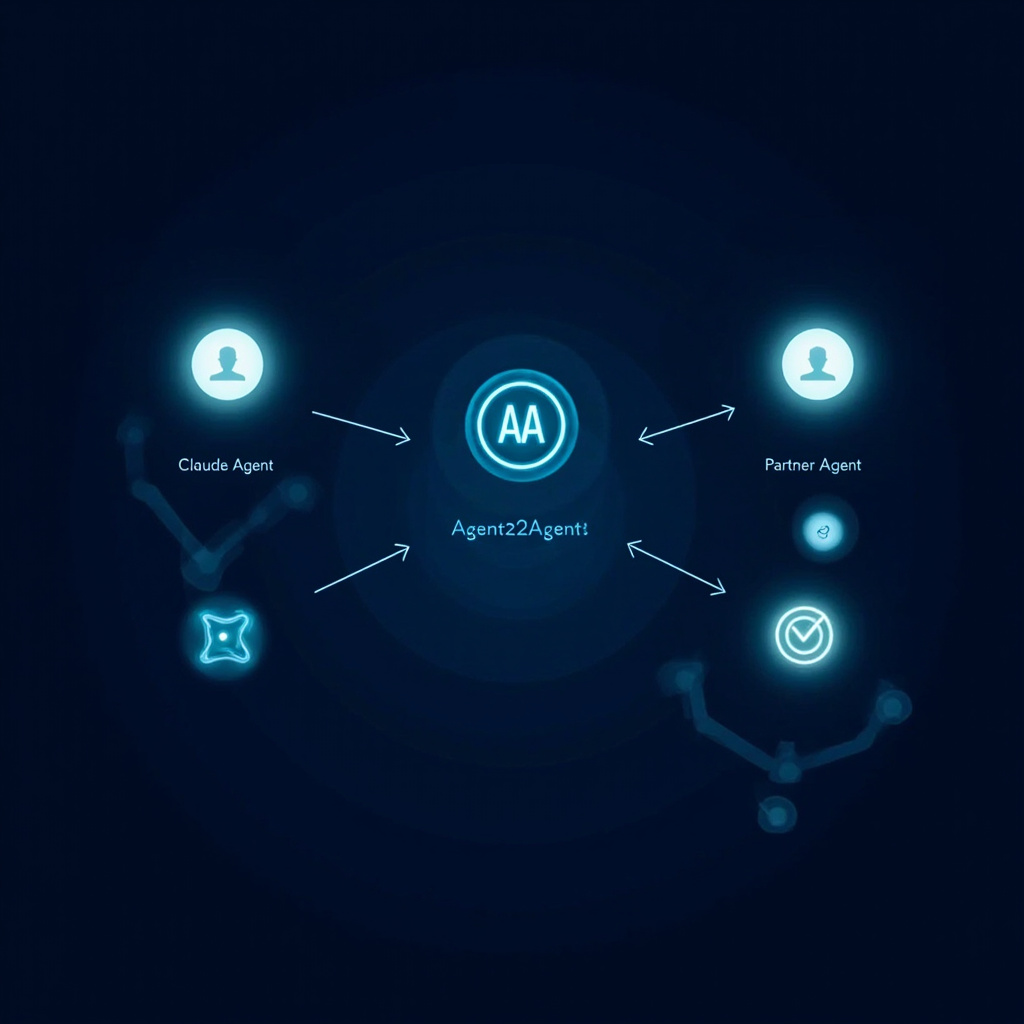
Perhaps the most significant infrastructure announcement at Google Cloud Next was the progress of the A2A (Agent-to-Agent) Protocol. Originally proposed by Google, the A2A Protocol provides a standardized way for AI agents from different vendors and organizations to communicate, negotiate, and collaborate with each other.
The numbers are impressive: 150 organizations are now running A2A in production environments, making it the de facto standard for multi-agent interoperability. Even more importantly, the Linux Foundation has taken over governance of the protocol, ensuring its development will be driven by the broader community rather than any single vendor.
The A2A Protocol solves a critical problem in the emerging agent ecosystem. As enterprises deploy agents from multiple providers — Claude for coding, Gemini for data analysis, specialized agents for HR, finance, and operations — these agents need a common language to coordinate their activities. Without A2A, each agent exists in a silo, unable to leverage the capabilities of others. With A2A, agents can discover each other, negotiate task allocation, share context, and deliver coordinated outcomes.
The Linux Foundation’s stewardship addresses concerns about vendor lock-in and ensures the protocol will evolve based on the needs of the entire ecosystem. This move mirrors the trajectory of other successful open standards like Kubernetes and GraphQL, which gained widespread adoption precisely because they were governed by neutral bodies.
Google’s $40 Billion Bet on Anthropic
The financial dimension of the Google-Anthropic relationship was impossible to ignore. Google announced a $40 billion investment in Anthropic, cementing what has become one of the most significant partnerships in the AI industry.
This investment isn’t just about capital — it’s about strategic alignment. Google’s cloud platform benefits deeply from Anthropic’s models, and Anthropic gains access to Google’s infrastructure, distribution channels, and enterprise relationships. The “After Software” thesis, after all, requires a robust cloud platform to deliver on its promise, and Google is positioning itself as that platform.
The $40 billion figure also signals Google’s confidence in Anthropic’s trajectory. In a market where AI valuations have been volatile and investor sentiment has fluctuated, Google’s willingness to commit this level of capital reflects a belief that Anthropic’s approach — combining frontier model capabilities with enterprise focus and safety research — represents the winning formula in the AI race.
Real-World Impact: Enterprise Adoption at Scale
The keynote wasn’t just about vision and demos. Burns grounded the “After Software” thesis with concrete enterprise adoption stories:
Palo Alto Networks has deployed Claude to 3,500 developers across the organization, using it for code generation, security analysis, and infrastructure automation. The company reports significant productivity gains, with developers completing tasks that previously took days in hours.
EY (Ernst & Young) is running agentic AI systems powered by Claude across 150 countries, automating audit processes, compliance checks, and client reporting. This represents one of the largest enterprise AI deployments to date and demonstrates that the agent paradigm scales across global organizations.
These examples illustrate a crucial point: the “After Software” transition isn’t theoretical. It’s happening now, at scale, across some of the world’s largest organizations. The question isn’t whether agents will replace traditional software — it’s how quickly the transition will occur.
The Unresolved Questions
Despite the compelling vision, several critical questions remain unanswered:
Agent Governance: When AI agents are making decisions, executing transactions, and interacting with external systems, who is accountable? How do enterprises ensure agents operate within policy boundaries, comply with regulations, and maintain audit trails? The current tooling for agent governance is immature, and the consequences of ungoverned agents could be severe.
Vendor Lock-in: While protocols like A2A and MCP promise interoperability, the reality is more nuanced. Enterprises that build deep integrations with Claude-specific agent patterns may find it difficult to switch providers. The open standards are necessary but not sufficient to prevent lock-in at the agent logic and orchestration layers.
Organizational Readiness: The “After Software” thesis assumes organizations can adapt their processes, culture, and workforce to an agent-centric paradigm. Many enterprises still struggle with basic digital transformation. The leap to agent-centric operations requires not just new technology but fundamentally new ways of thinking about work, management, and value creation.
The Road Ahead
Google Cloud Next 2026 may be remembered as the moment the enterprise software industry began its transformation from applications to agents. Anthropic’s “After Software” thesis, backed by Google’s platform investments and the A2A Protocol’s growing ecosystem, presents a coherent and increasingly credible vision of the future.
The transition won’t happen overnight. Traditional software will coexist with AI agents for years, perhaps decades. But the direction is clear. The companies that begin building their agent strategies today — experimenting with MCP integrations, deploying A2A-compatible agents, and rethinking their software architectures around agent primitives — will be best positioned for the world that’s rapidly approaching.
After software, what comes next? If Anthropic and Google have their way, the answer is agents — intelligent, autonomous, and endlessly adaptable digital workers that render the very concept of “software” obsolete.
Related Articles
Anthropic Doubles Claude Code Rate Limits —SpaceX Colossus Deal Revealed
Anthropic quietly doubled Claude Code rate limits across all paid tiers, backed by a compute partner...
Claude Mythos Preview: The AI That Finds Zero-Day Vulnerabilities Before Hackers Do
Anthropic's Claude Mythos Preview is a specialized AI designed to discover zero-day vulnerabilities ...
Claude Code Auto Mode: The Permission Fatigue Solution
Anthropic's Auto Mode for Claude Code solves the biggest pain point in AI-assisted coding: constant ...